
Agriculture contributes 30% of Kenya’s GDP and employs over 40% of the population. Learn how agribusiness and value-addition investments in Kenya offer strong returns for local and foreign investors.
Investing in Agribusiness in Kenya: Unlocking Value Through Processing and Export
Agriculture has long been the backbone of Kenya’s economy. Contributing approximately 30% of national GDP and employing over 40% of the population, the sector remains central to economic growth, food security, and export earnings. While traditional farming continues to play a vital role, the greatest investment opportunities today lie in agribusiness and value addition—turning raw agricultural produce into higher-value, market-ready products.
For both foreign and local investors, agribusiness in Kenya offers a compelling combination of strong demand, export potential, and government support. This blog explores where the opportunities lie, typical investment costs, expected timelines, and strategies for success.
Why Agribusiness Is a Strategic Investment in Kenya
Kenya’s agricultural strength is built on:
- Favorable climate zones
- Diverse crop and livestock production
- Access to regional and international markets
- Established smallholder farming networks
However, a significant portion of agricultural exports still leave the country in raw or semi-processed form. This creates a value gap—and an opportunity—for investors who can process, package, brand, and export finished products.
Key Agribusiness Investment Segments
1. Food Processing and Value Addition
Food processing is one of the most attractive agribusiness investment areas in Kenya. By adding value locally, investors benefit from:
- Higher margins
- Reduced post-harvest losses
- Strong domestic and export demand
High-potential processing areas include:
- Tea and coffee processing
- Dairy products (milk, cheese, yogurt)
- Fruit juices and concentrates
- Grain milling and animal feeds
- Edible oils and nuts
Typical investment costs:
- Small-scale processing: USD 50,000–250,000
- Medium-scale facilities: USD 300,000–2 million
Timeframe to market:
- 6–18 months depending on licensing and scale
2. Export-Oriented Farming
Export agriculture remains a major foreign exchange earner for Kenya. Products such as flowers, fresh vegetables, avocados, macadamia nuts, and mangoes are in high demand in Europe, the Middle East, and Asia.
Advantages of export-oriented farming:
- Access to premium international pricing
- Established export logistics and trade agreements
- Year-round production in some regions
Key considerations:
- Global G.A.P. and food safety certification
- Cold-chain and logistics infrastructure
- Currency and market risks
Typical investment range:
- Medium-scale export farm: USD 100,000–500,000
- Large commercial operations: USD 1 million+
Payback period:
- 2–5 years depending on crop cycle
3. Horticulture and High-Value Crops
Kenya is a leading producer of horticultural products. Investment opportunities exist in:
- Greenhouse farming
- Organic and specialty crops
- Contract farming models
Horticulture benefits from relatively short production cycles and strong export demand.
4. Livestock and Animal Products
Livestock contributes significantly to rural incomes and offers opportunities in:
- Meat processing
- Poultry and egg production
- Leather and hides processing
Value-added livestock products can serve both domestic and regional markets.
Government Support and Incentives
The Kenyan government actively promotes agribusiness investment through:
- Tax incentives for agro-processing
- Export promotion programs
- Special Economic Zones (SEZs) and industrial parks
- Support for irrigation and mechanization
These initiatives aim to shift agriculture from subsistence to commercial and export-oriented production.
Foreign Investors vs Local Investors: Different Approaches
Foreign Investors
Strengths:
- Access to capital and technology
- Export market connections
- Experience in large-scale operations
Common strategies:
- Joint ventures with local partners
- Export-focused processing facilities
- Contract farming with smallholders
Challenges:
- Land ownership restrictions
- Regulatory navigation
- Community engagement
Local Investors
Strengths:
- Knowledge of local supply chains
- Easier access to labor and land leases
- Strong relationships with farmers
Common strategies:
- Small-to-medium processing plants
- Aggregation and logistics businesses
- Domestic and regional market focus
Challenges:
- Access to affordable financing
- Scaling operations
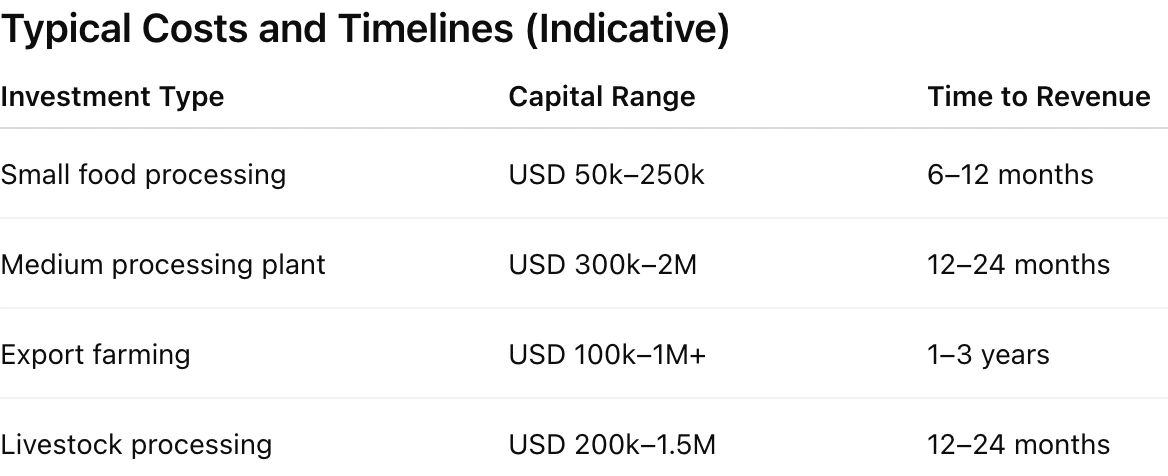
Typical Costs and Timelines (Indicative)
Risks in Agribusiness Investment
Key risks include:
- Climate variability and drought
- Market price fluctuations
- Logistics and infrastructure gaps
- Regulatory compliance issues
Risk mitigation strategies:
- Irrigation and climate-smart farming
- Crop diversification
- Long-term supply contracts
- Insurance and hedging
The Role of Technology in Agribusiness
Technology is transforming Kenyan agriculture through:
- Precision farming
- Mobile-based farmer aggregation
- Cold-chain logistics solutions
- Digital marketplaces
Investors who integrate technology gain efficiency and scalability advantages.
Why Value Addition Is the Future
Kenya’s agribusiness future lies in:
- Processing more produce locally
- Reducing reliance on raw exports
- Building recognizable African brands
- Creating jobs and rural income
Value addition increases resilience and profitability across the agricultural value chain.
Final Thoughts
Agriculture may be Kenya’s oldest economic pillar, but agribusiness and value addition represent its future. With strong fundamentals, government support, and growing global demand for high-quality agricultural products, Kenya offers one of Africa’s most compelling agribusiness investment environments.
For investors willing to engage with supply chains, build partnerships, and adopt modern production methods, agribusiness in Kenya delivers both financial returns and long-term impact.